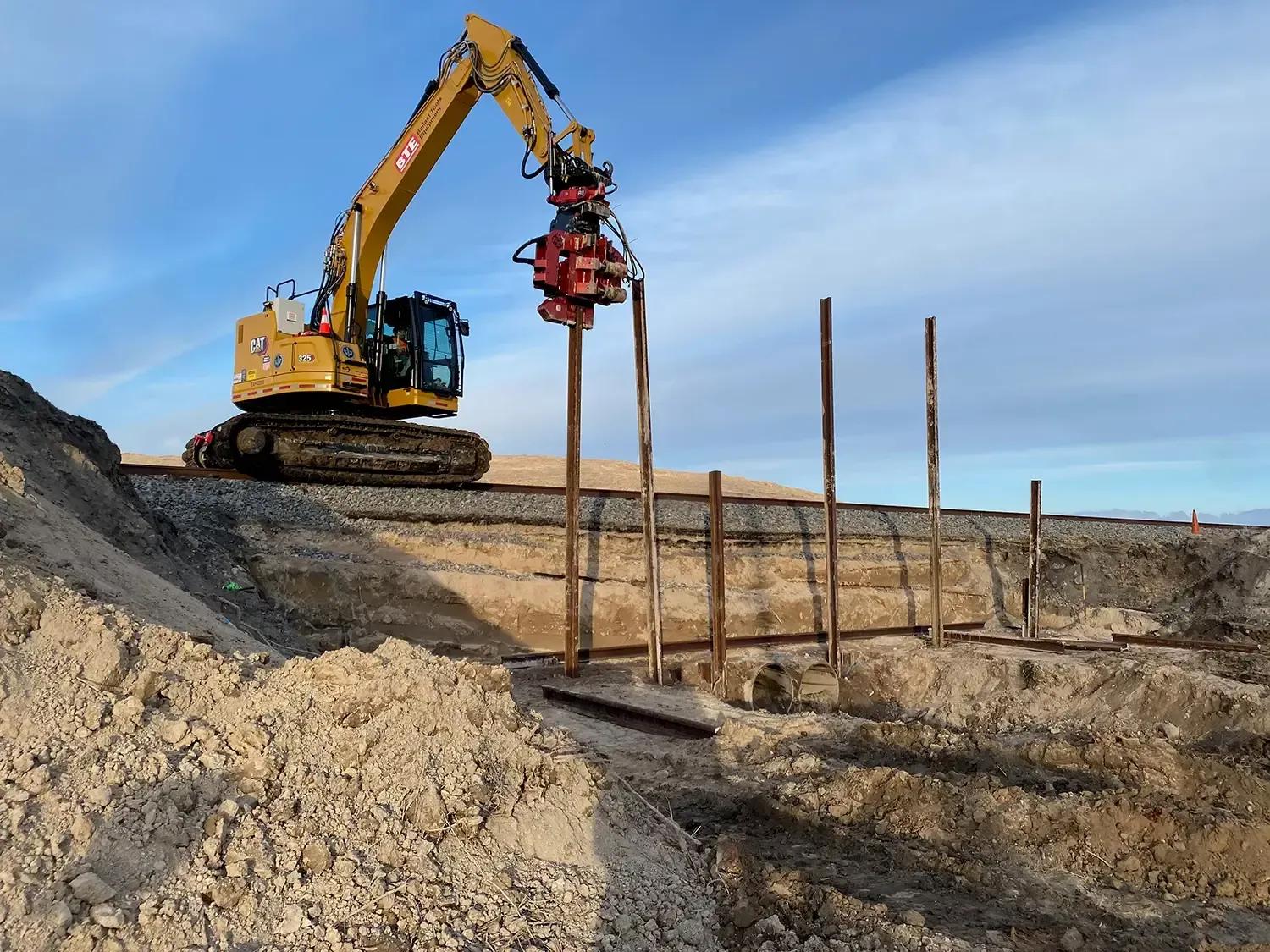


A vibratory hammer spec sheet is a short list of numbers that describe how hard the hammer shakes, how much hydraulic oil it needs, and how big a pile and carrier it suits. Learning how to read vibratory hammer specs comes down to four questions: how much force the hammer makes, how far the pile moves each cycle, what flow and pressure the power pack must supply, and what weight the hammer and pile add to your machine. Answer those, and the rest of the table falls into place.
Most buyers scan a table once, see a big force number, and assume bigger is better. In practice, a hammer that outruns your excavator's hydraulics or weight class will stall, overheat or stress the boom. A short background read on how vibratory hammers work helps before you compare models. This guide walks through each row you are likely to see, in the order it usually appears.
What Is Eccentric Moment on a Vibratory Hammer?
Eccentric moment is the amount of off-center weight inside the hammer's gear case, multiplied by how far that weight sits from the shaft center. It is usually written in kilogram metres (kg·m) or inch-pounds. Inside the hammer, pairs of weighted gears spin in opposite directions. Side forces cancel, and what is left is a strong up and down shake.
Think of vibratory hammer eccentric moment as the hammer's stroke potential. A larger eccentric moment moves the pile further on each cycle for the same total weight. That matters most in loose or sandy soils, where movement liquefies the grains around the pile and lets it slide down.
Rated eccentric speed sits next to it. This is how fast the eccentric shafts turn at full flow, in revolutions per minute (rpm). Speed matters because force rises with the square of speed, so a modest rpm gain makes a noticeable force difference. High-frequency units are often chosen near buildings because they pass quickly through the low frequencies that shake nearby ground.
What Does Centrifugal Force Tell Me About a Hammer?
Centrifugal force is the peak shaking force the hammer produces at its rated speed, listed in kilonewtons (kN) or tons of force. It comes directly from the eccentric moment and the rated speed. Double the eccentric moment and force doubles. Raise the speed by half and force roughly doubles again, because of that squared relationship.
Vibratory hammer centrifugal force is the headline number on most data sheets, but on its own it tells you little. A heavy hammer and a light hammer can share the same force rating and behave very differently. Force must overcome skin friction along the pile and resistance at the toe. Soil reports, pile length and pile surface area decide how much you need.
Maximum Amplitude and Why It Matters More Than Force
Amplitude is how far the pile head actually travels in one cycle, usually in millimetres or inches. It equals the eccentric moment divided by the total vibrating weight, which is the hammer's vibrating case, the clamp, and the pile itself. Spec sheets list maximum amplitude with no pile attached, so your real amplitude on site will always be lower.
This is the practical lesson behind vibratory hammer amplitude: a long, heavy pipe pile drags the number down. If you drive heavy sections, favour a hammer with a generous eccentric moment rather than the one with the loudest force figure.
How Do I Match Hammer Flow and Pressure to My Power Pack?
Rated flow is the volume of hydraulic oil the hammer needs each minute to reach its rated speed, in litres per minute (L/min) or gallons per minute (GPM). Working pressure is the pressure the circuit must hold to deliver that flow, in bar or psi. Flow controls speed. Pressure reflects the load the hammer is working against.
Supply less flow than rated and the hammer turns slower, which cuts force sharply. Supply more than rated and you risk heat and damage. Watch the units carefully, because tables sometimes mix psi and bar in the same document. One bar is about 14.5 psi, so 350 bar is roughly 5,000 psi. If a cell looks blank, mislabelled or impossible, ask for the source data sheet before you plan around it.
Check three things against your carrier before you shortlist a hammer:
- Available flow at the auxiliary circuit, measured at working engine speed, not the brochure maximum.
- Relief setting and hose size, since undersized lines drop pressure before the oil reaches the hammer.
- Return and case drain capacity, which many excavators need added before an attachment will run properly.
If your machine cannot supply the rated flow, a separate diesel power pack is the usual answer. Our guide to hydraulic power pack selection covers how to size one against the hammer's rated flow and pressure.
What Do Line Pull and Piling Element Weight Mean?
Maximum line pull is the upward pull the hammer can apply when extracting a pile, listed in kN or tons. Extraction often needs more force than driving, because soil has gripped the pile and, in clays, suction adds resistance. If pulling temporary sheets is part of the job, treat line pull as a primary number rather than a footnote.
Maximum piling element weight is the heaviest pile the clamp and hammer are rated to hold and drive. Compare it against your actual section weight, not a nominal figure. Clamp load, which is the force the jaws apply to grip the pile, appears on some sheets as well. Too little clamp force and the pile slips; the wrong jaw type will not hold a pipe or an H-pile at all.
Weight, Sound Power and Transport Size
Weight is the hammer's own mass, with or without the clamp and suppressor depending on the sheet. Add the pile weight and check the sum against your excavator's lift chart at full reach, not just at the boom's strongest position.
Sound power is the noise energy the machine emits, in decibels (dB). It is not the same as sound pressure measured at a set distance, which is the figure most local noise rules use. Comparing the two directly will mislead you. Transport size is the shipping length, width and height, which decides whether the hammer travels on a standard trailer or needs a permit.
Quick Reference Table
| Spec row | Typical units | What it decides |
|---|---|---|
| Weight | kg or lbs | Whether your excavator or crane can lift it safely |
| Rated eccentric speed | rpm | Driving speed and how much force the hammer reaches |
| Eccentric moment | kg·m or in·lb | How far a loaded pile moves per cycle |
| Centrifugal force | kN or tons | Peak shaking force against soil friction |
| Maximum amplitude | mm or in | Movement with no pile; real figures run lower |
| Rated flow | L/min or GPM | Whether your carrier or power pack can run it |
| Working pressure | bar or psi | Required relief setting and hose rating |
| Maximum line pull | kN or tons | Extraction capacity for temporary piles |
| Max piling element weight | kg or lbs | Heaviest pile section the clamp can hold |
| Sound power | dB | Noise energy emitted; not a site boundary reading |
| Transport size | L x W x H | Trailer type and whether permits apply |
How Do You Match a Hammer to Your Pile and Carrier?
Work through the spec sheet in this order. The figures below are a hypothetical illustration using round numbers, not a real project or a quoted model.
- Start with the pile. Say you are driving 30 ft sheet piles weighing about 900 lbs each into medium sand.
- Check maximum piling element weight. The hammer must be rated above 900 lbs, with margin for splices or wet sections.
- Check clamp type. Sheet piles usually take a side grip clamp; pipe piles often need a different jaw.
- Estimate amplitude. Divide the eccentric moment by the combined weight of the vibrating case, clamp and pile. If the result is too small for your soil, step up the eccentric moment rather than the rpm.
- Add the weights. If the hammer and clamp weigh 2,200 lbs and the pile adds 900 lbs, your carrier must lift about 3,100 lbs at the reach you will actually work at.
- Confirm hydraulics. Compare the rated flow and working pressure with your excavator's auxiliary circuit, or budget for a power pack.
- Confirm extraction and transport. Check line pull against the pull you expect, then check transport size against your trailer.
If your machine sits in a mid-size class, an excavator mounted pile driver keeps the setup simple, since the carrier supplies the lift and, in many cases, the oil. Heavier or longer piles usually move to a crane suspended unit.
Where Can I Find the Spec Sheet for a Specific Model?
Ask the supplier for the current data sheet for the exact model and clamp combination you are considering, and confirm the figures in writing before you order. Published tables and brochures are often out of date, and the same model can ship with different clamps, suppressors or hose kits that change weight and transport size.
When a sheet gives a range rather than a single number, ask which end applies to your configuration. When two sources disagree, treat the manufacturer's latest sheet as the one to plan from. Pile Driving USA can confirm specs for a specific hammer against your carrier and pile when you request a quote or a free consultation.
Frequently Asked Questions
Eccentric moment is the off-center weight inside the gear case multiplied by its distance from the shaft center, shown in kg·m or inch-pounds. It sets how far a loaded pile moves each cycle. A higher eccentric moment keeps amplitude usable when you drive long or heavy sections.
No. Centrifugal force must suit the soil, pile and carrier together. A high-force hammer that your excavator cannot lift or supply with oil will underperform and risk damage. Check force alongside eccentric moment, weight and rated flow before you shortlist a model.
Published maximum amplitude is measured without a pile attached. On site, the clamp and pile add to the vibrating weight, so the same eccentric moment produces less movement. Heavier piles cut amplitude the most, which is why long pipe sections often need a larger hammer.
The eccentrics turn slower than rated speed, so the hammer makes less force and drives more slowly. Oil temperature may also rise. Measure flow at working engine speed, and use a diesel power pack when the carrier circuit cannot meet the hammer's rated flow.
Not directly. Sound power describes the noise energy a machine emits, while most ordinances measure sound pressure at a property line or set distance. Use sound power to compare machines, then have site noise assessed against the rules that apply to your location.
Multiply bar by 14.5 to get psi, or divide psi by 14.5 to get bar. So 350 bar is about 5,075 psi. Mixed units are a common source of error, so confirm the unit on every pressure row before setting relief valves or ordering hoses.
Putting Your Vibratory Hammer Specs Into Practice
Once you know how to read vibratory hammer specs, the table stops being a wall of numbers and becomes a checklist. Work from the pile outward: element weight and clamp type, then eccentric moment and amplitude, then flow and pressure, then lift capacity, line pull and transport size. That order catches mismatches early, before a hammer arrives that your carrier cannot run. Comparing a vibratory hammer for an excavator against your own machine's figures is the fastest way to narrow a shortlist.
Pile Driving USA sells and rents hydraulic vibratory pile drivers, power packs, clamps and dampers, and can review a spec sheet against your pile type and carrier. Request a quote or a free consultation at Pile Driving USA.